

📊 The real impact of a great product advisor, and the cost of building it yourself

A good product advisor is one of the few things on an e-commerce site that moves revenue on its own. It guides a shopper to the right product and lifts conversion while it does. Done well, it raises the size of the average order too. That upside is exactly why so many teams set out to build their own, and it is also the upside most of them never fully capture.

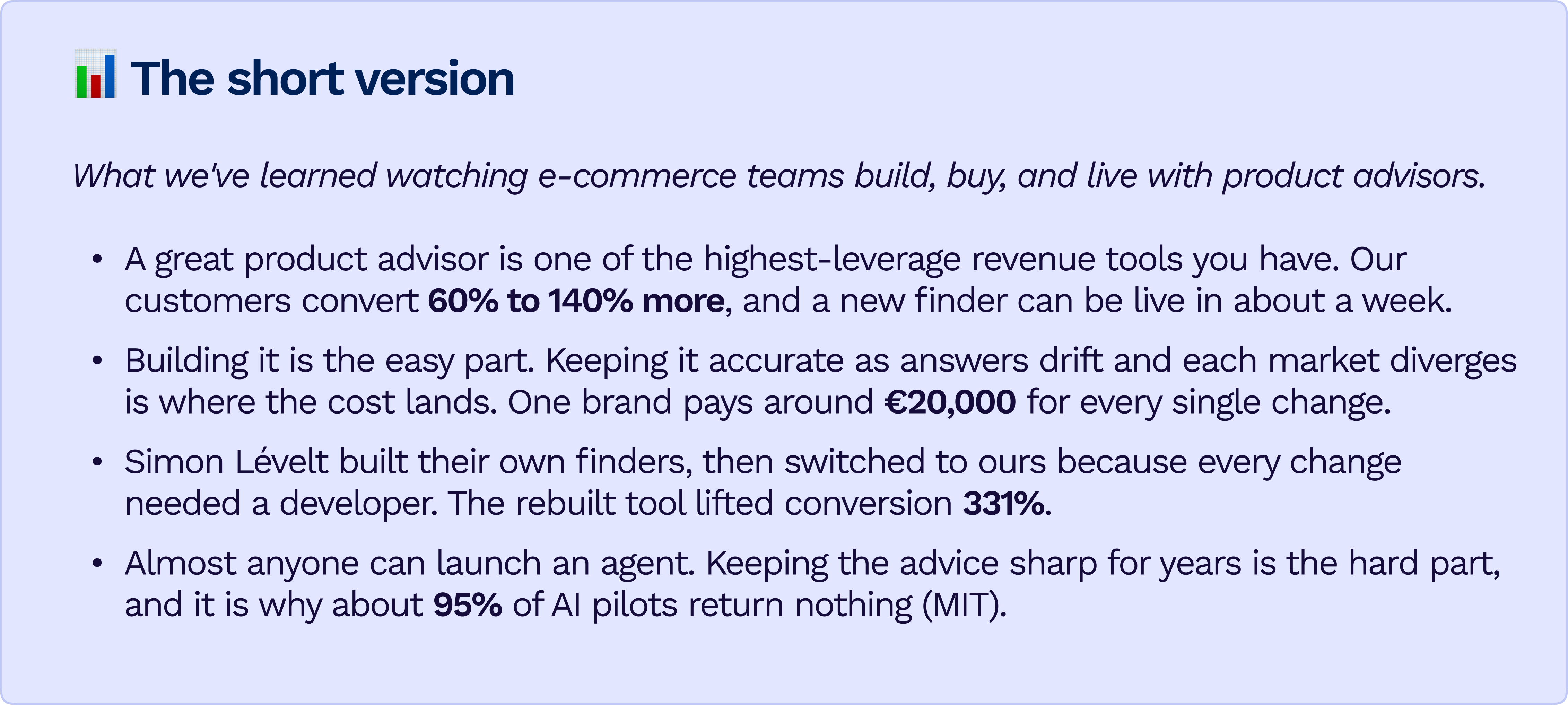
Take a European retailer we spoke with. They built their own AI product advisor and launched it, and conversion climbed. By every measure it worked, and they would still tell you to think twice before doing the same. The tool paid off, though nowhere near what it could have, and that gap is the whole story.
That's the part everyone skips in the build-versus-buy debate. Type the phrase into your browser and you'll find dozens of articles explaining why buying is the only sensible answer. I won't argue with them. Coming from us, that would be a little rich. What I never see anywhere is the first-hand version, the account from the people who actually did the building. We've spent ten years at Aiden listening to e-commerce leaders, so here is what they told us, in their own words.
Building is the easy part
For that retailer, the build itself went smoothly. The trouble started once the thing was live and wouldn't hold still.
“It works, but it's inconsistent. You can ask the same question ten times and get eight different answers.”
A language model drifts, and every drift has a price. A shopper who gets a shaky or off-brand recommendation is a shopper who doesn't buy, so the inconsistency shows up straight away in conversion. Keeping its answers accurate and on brand isn't a one-time launch task, it's a standing commitment. In the end, they told us, it cost more than buying would have. They had swapped a build project for a permanent maintenance job, one person whose whole week now goes to keeping the thing running.
A large international manufacturer hit the same wall from a different direction. They built a single product finder to cover every market, and it held up right until one region spoke up.
“We built this international flow: six questions, a couple of variants,” their lead told us. “Then one region raised their hand and said, 'we don't sell those products here, we need to focus on the range we actually carry.' In the current setup, it's very difficult to manage variants of the same tool.”
One straightforward change, she added, could run to around €20,000. Building the finder had been cheap. The real cost lay in keeping it current, and a finder that can't keep up with what each market actually sells quietly caps how much it can earn.
It never reaches the top of the list
The failure we see most often is quieter than either of those. A premium appliance brand built finders for four of its markets. All four are still live and quietly underperforming, and nobody is fixing them. The team has the budget and the skills. What they are short on is room. The work sits in a queue behind everything else the business is asking of them. So the finders keep converting at a fraction of what they could, leaking revenue every day that nobody circles back to recover.
Their marketing lead put it plainly:
“There are always more initiatives than capacity to deliver them.”
Every hour an engineer spends nursing that finder is an hour they can't spend building something only your team can build. This is how most of these projects actually end. They don't get shut down in any dramatic way, they just slide down the priority list until everyone stops asking about them. The numbers back this up: Gartner expects more than 40% of agentic AI projects to be cancelled by the end of 2027 due to escalating costs, unclear business value or inadequate risk controls.
It's never just a tech decision
You might expect the technology to be the thing that trips people up. It rarely is, though it is genuinely hard and getting harder. The models shift every few months, and keeping pace takes current, hands-on expertise that most teams can't spare on top of their real jobs. Even so, the technology is seldom what kills a project. Politics is. The decision travels through layer after layer of the business, the commercial side pushing to move fast, IT wanting to own the whole thing. One retailer described the standoff inside their own walls without much diplomacy:
“There are companies whose entire job is this. We'll never reach that level building it ourselves.”
You already outsource everything else
Here is what most companies miss while they weigh this up. They already hand off work that sits far closer to the customer than a product finder ever will. Their live chat runs through an outside partner. So do their payments. Nobody in the building calls that a loss of control. No, they call it staying focused on what they are genuinely good at.
Something that I haven’t touched on is that most people simply like building. There is a real thrill in making something from scratch, a pull to own it from end to end. That pull is exactly where teams get caught. Your people are capable, and wanting to keep control is completely fair. I get it. But running a business comes down to putting your best people where they move the needle, and right now the numbers all point the same way. Your core business is selling products. The advice engine can be someone else's whole job.
When it's someone's whole job
Think about what you actually get on the other side of that decision. You don't get a finished product, and that is the point, because it never finishes. You get a team who does this and nothing else. When the models change, they have already tested what moved. When conversion slips in one market, sorting it out is the first thing on someone's desk that morning, because improving the advice is the whole job. Every one of those fixes lands where it matters, in conversion and revenue that a neglected finder simply leaves behind.
None of this means handing over the keys. In practice it looks like your team and a specialist working side by side. You keep commercial control and you own the roadmap. They keep the advice sharp and stay accountable for how it performs. You hold on to ownership the whole way through. The only thing that changes is where you point your team's attention.
What building looks like, what buying looks like
Set the two side by side and the choice stops being abstract. Building looks like the stories above. The finder ships on time (well, not always) and works on launch day. Then it starts to drift, and keeping it accurate across every market becomes a standing job that waits behind everything else the team owes the business. It rarely gets killed outright. It just earns less than it should while someone's week disappears into it.
Buying looks like Simon Lévelt. They are a premium coffee and tea brand, and they had already built their own coffee and tea finders in-house. The finders worked, but the team could not see where shoppers dropped off or which answers came up most, and any change meant booking developer time. That kind of insight and flexibility came built in with us, their e-commerce coordinator Roxanne van Baardewijk told us, so the decision to switch was quick. They rebuilt the Coffee Finder in a day and launched it the next. In the first month, conversion among finder users was up 331%, and the data they had been missing was finally there, right down to the 56% of users who take their coffee black. The Tea Finder is moving over too.
Simon Lévelt is not alone in the numbers. Prénatal's baby-monitor finder converts 5x better than its category page, and Goossens lifted conversion 138% within three weeks of launch. MediaMarkt now runs more than 150 of these finders across its markets. What none of these teams is doing is spending its weeks nursing a model to keep it that way.

Launch, or capability
Almost anyone can launch an AI agent now. Far fewer can keep the advice behind it getting sharper year after year. That is the choice that actually matters, and it has very little to do with building versus buying. Advice isn't a project you finish and walk away from. It's something you keep.
Own the advice layer before someone else does.
Shoppers are going to ask AI what to buy. Make sure your brand has the answer.
