

💬 Why product advice is becoming the new standard in e-commerce

E-commerce is changing: shoppers expect advice that feels as natural as an in-store conversation. A Product Advice Agent brings that online, combining structured guidance with flexible AI conversation, so brands can help shoppers decide with confidence — even when they go off-script.

For years, e-commerce teams have been trying to recreate online something that feels completely natural in-store: getting the right advice at the exact moment a shopper needs it.
That's work we've been doing for years, helping brands bring guided selling online through product finders, and continuously optimising them so shoppers land on the right choice. And that foundation isn't going away.
Except that, now, AI is here. What AI changes isn't that advice belongs online, but how far that advice can go. It makes it possible to bring the kind of off-script conversation online that, until now, only really happened in-store.
Let me make that concrete with a little visualisation exercise.
Picture someone walking into a store looking for headphones. They do not have a perfectly defined need yet, so the salesperson starts with the usual questions:
- What will you use it for?
- What matters the most to you?
- What kind of budget do you have in mind?
Until the conversation shifts. After all, it usually does.
The shopper suddenly mentions they are training for a marathon, so they need something that can handle sweat and rain. Oh, and they would prefer a darker colour, by the way. That is when the conversation takes over the script.
This happens every day in-store. And a great salesperson does not break when it happens. They adapt, connect the dots, and guide the customer toward the right choice without losing momentum.
AI can help bring exactly that online. And it matters more than ever, because advice was always important, but now it is urgent.
Why conversational commerce matters now
AI has changed the baseline expectation. Today, nearly 30% of product searches start with AI, an Adobe Insights report suggests.
People are getting used to asking open questions and receiving immediate answers. That behaviour does not stop when they land on an e-commerce site. Instead, it has become a new expectation.
That does not mean every brand suddenly needs a chatbot.
A generic chatbot or AI shopping assistant can sound fluent, but fluency is not the same as good advice. It does not know your catalogue the way you do, nor does it understand your business logic, your commercial priorities, or what your brand would actually recommend in a real buying moment. In short, you need to be in control of the process.
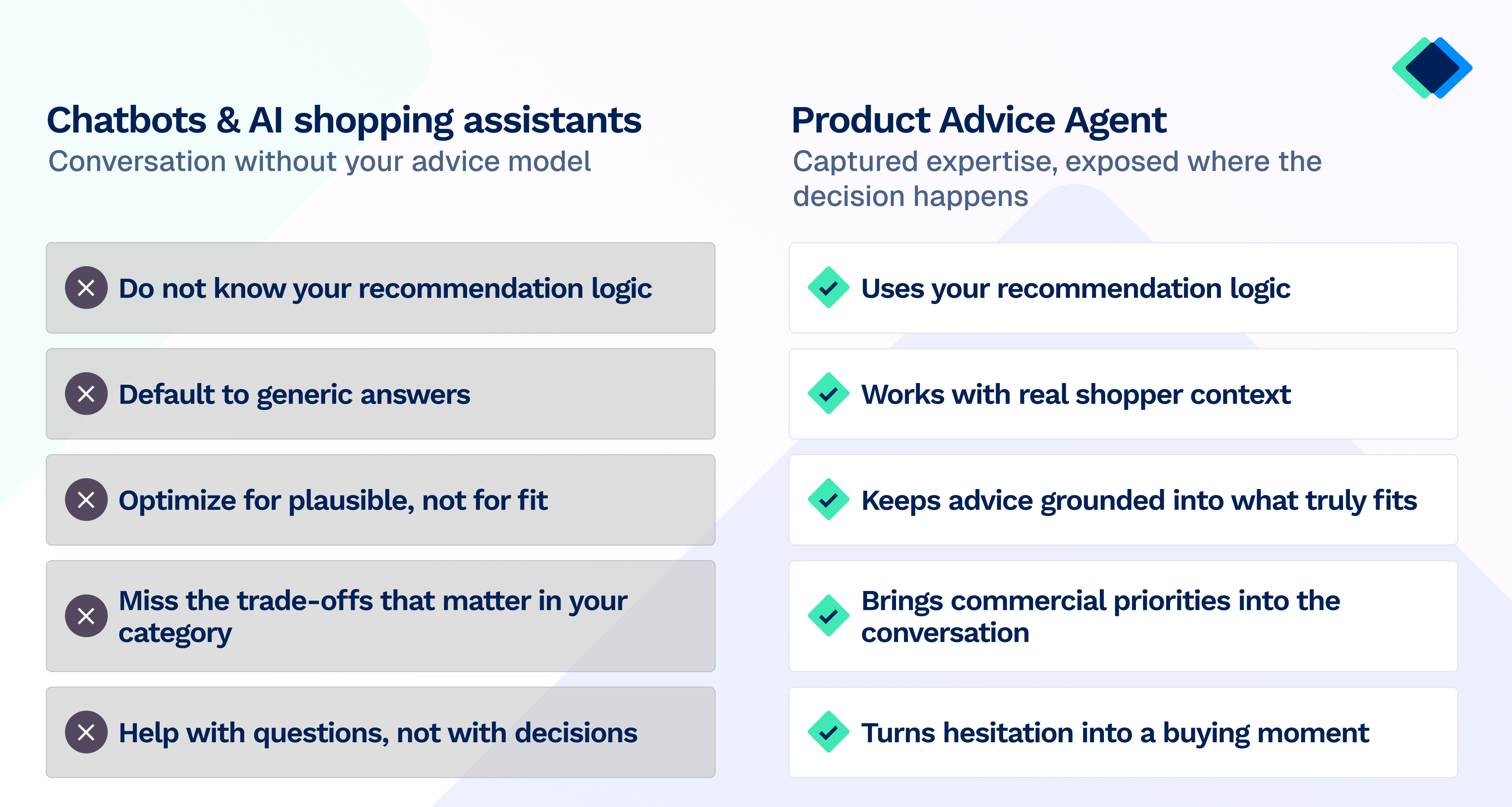
What commerce needs is not simply more conversation. It needs conversation that still leads to the right decision.
If you can't guide the decision, you lose the sale
The hardest part of e-commerce is not getting someone onto a product page. It is helping that person decide once they get there.
A shopper can arrive with strong intent and still hesitate at the exact moment that matters most. In that moment, the difference between conversion and drop-off is rarely more information but better guidance.
That is why I keep coming back to Marja’s point in this LinkedIn post: brands will happily pay to get a shopper onto a product page, then leave them alone with the hardest part: deciding.
From product recommendation quiz to Product Advice Agent
This is exactly where the Product Advice Agent comes in.
Structured guidance remains the fundament. What's new is that you decide how that advice is delivered: fully scripted, AI-assisted, or fully agentic. You choose the level of control that fits each journey.
The Agent can do something a scripted or AI-assisted flow can't: handle the moments a shopper goes off-script. In our live tests, that happened around 20% of the time.
It brings together the control of structured advice and the flexibility of conversation, so shoppers can ask in their own words while every recommendation still fits, still sells, and still reflects what matters commercially.
The Product Advice Agent extends the boundaries of guided selling. It captures your expertise and exposes it in the moments where the decision actually happens.
Two examples that make the point
Example #1: the headphone conversation
Let us get back to our little visualisation exercise. A shopper is looking for headphones and starts in a fairly standard place. Who are they for? Is noise cancelling important? These are all questions a standard guided selling tool usually handle.
But then the shopper goes off-script. When asked whether comfort is the main priority, they answer that battery life matters most. That is where the Aiden Agent adapts like a real salesperson would, without missing a beat. Put differently: this is where conversation and your own advice logic guide the sale.

Example #2: the pillow conversation
Now let us take a category where comfort matters even more. A shopper is looking for a new pillow and is asked which sleeping positions are most common. Because relieving back and shoulder tightness is what matters most in the decision, the shopper brings it up early, unprompted. The Aiden Agent follows through by recommending pillows designed for exactly that.
Then comes another constraint: the shopper only wants vegan materials. A chatbot or generic AI shopping assistant would usually stumble here. A Product Advice Agent does not. It adapts the recommendation to take both criteria into account.

The metric I keep coming back to
If all of this produced more engaging conversations but no commercial effect, it would be interesting and not much more.
What makes it matter is that it performs.
Across our tests, conversational advice delivered an average +13% click-through lift.

The shift
For a long time, great advice was one of the least scalable advantages in commerce. It lived in your best salesperson, your best category expert, or your best-designed flow.
Now it can live in more places.
If you get this right, your expertise stops being trapped in one format. It becomes available wherever shoppers hesitate, compare, doubt, or decide.
That is why I do not think the next decade of e-commerce will be won by the brands with the most AI. It will be won by the brands that expose the best expertise, in the moments that matter most.
Are you ready to win the next decade of e-commerce?
Own the advice layer before someone else does.
Shoppers are going to ask AI what to buy. Make sure your brand has the answer.
